Do You Need an Air Compressor for a Nail Gun?
No — not any more, and the arithmetic is the reason. A pneumatic brad nailer plus the cheapest compressor we could find costs more than a complete cordless gun that needs neither. Here's the math, and when a compressor still earns its place.

- Category
- Nailers & Fastening
- Tools tested
- 5
- Read time
- 12 min
- Updated
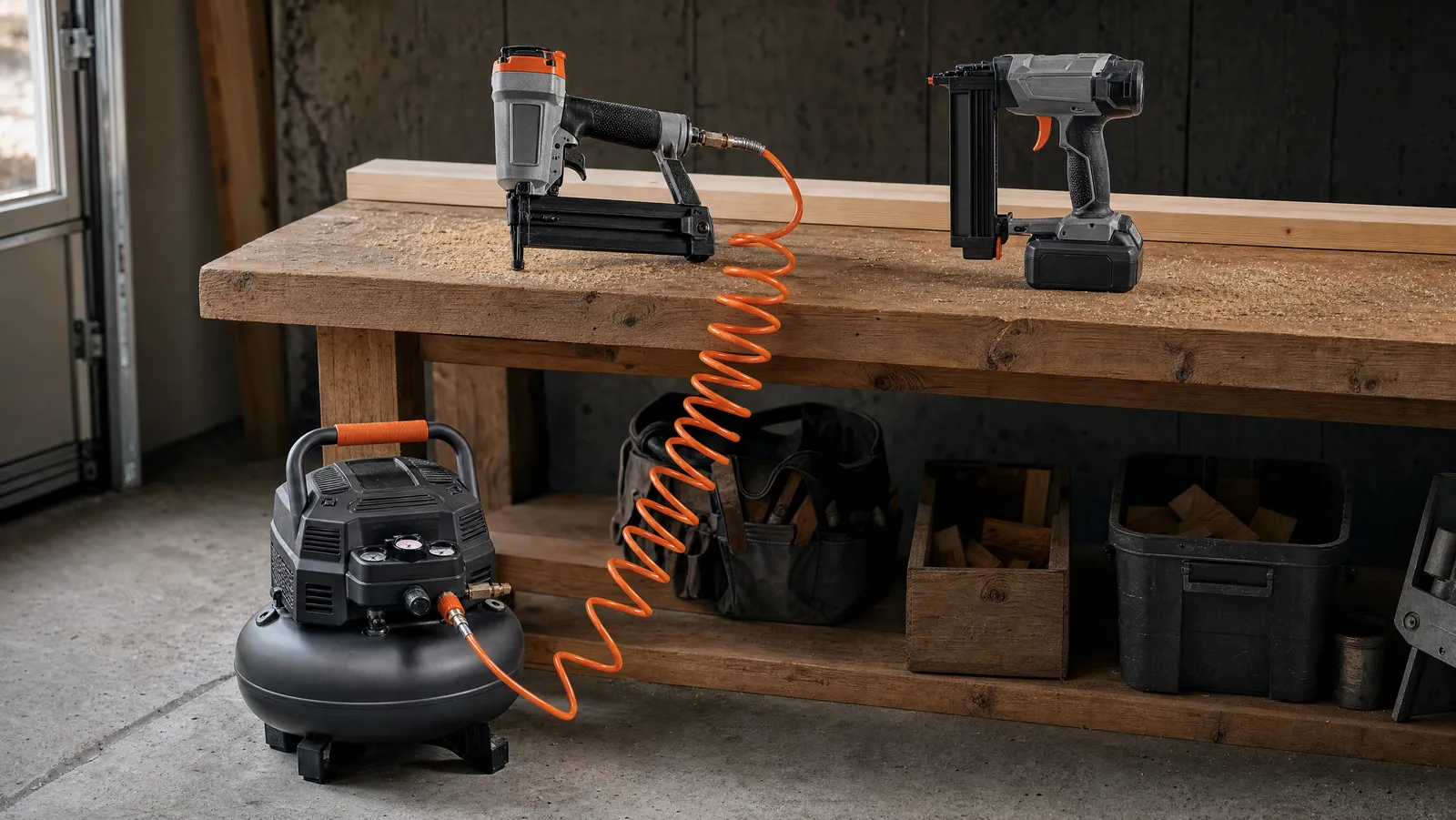
No — not any more. If a brad nailer is all you want, the cheapest pneumatic gun plus the cheapest compressor we could find comes to $109.15, while a complete cordless gun that needs no air at all is $108.00, both as of November 2026. The compressor is now the expensive habit, not the shortcut.
That $1.15 gap is small, and the smallness is exactly the point: the pneumatic bargain has quietly stopped being a bargain. If you are still assembling a kit from scratch, start with our essential DIY tools list, then our nail gun buying guide for which gun to get. This page is about the decision that catches people at checkout.
The short answer
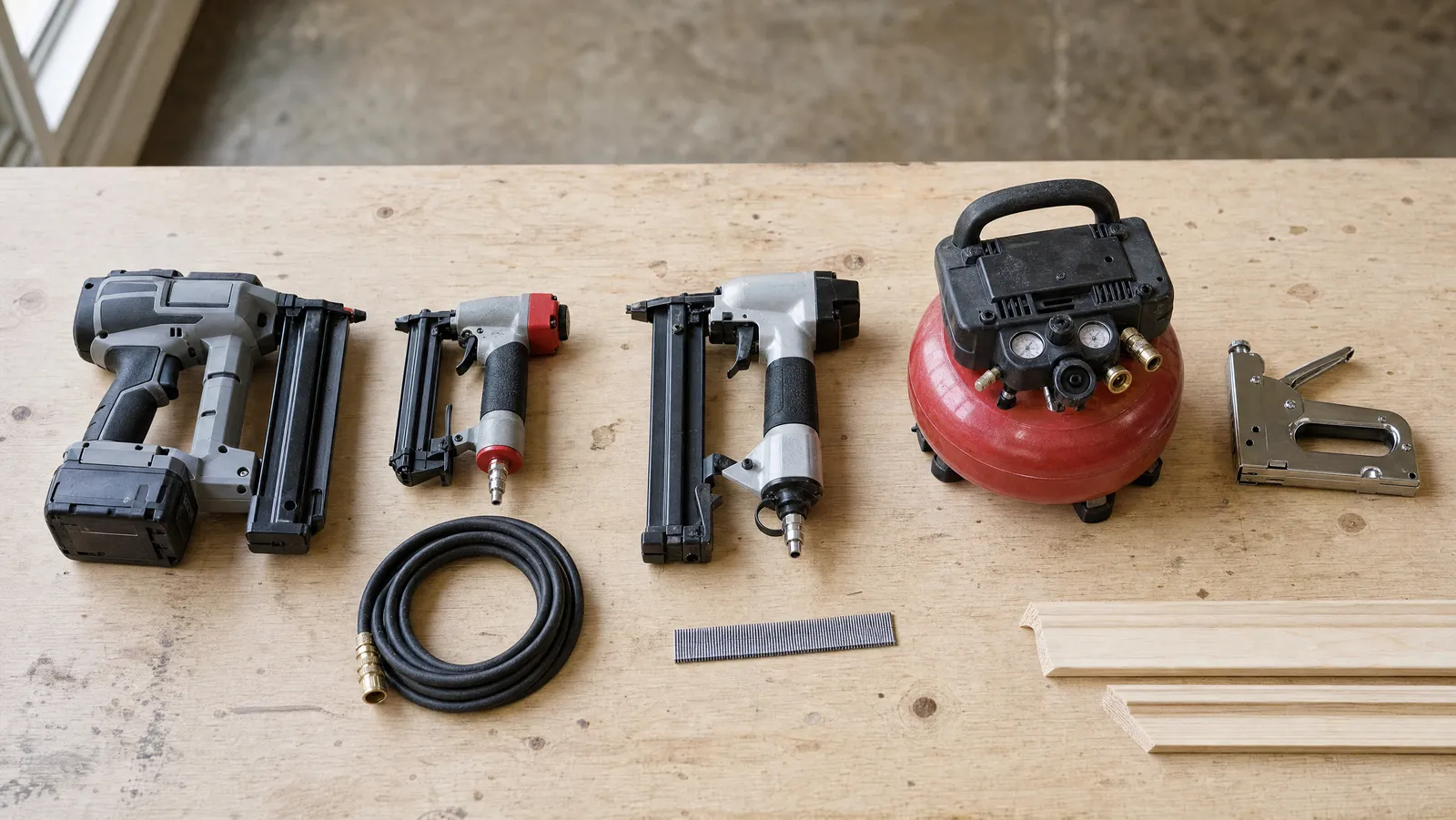
Do you need an air compressor for a nail gun? Only if the gun is pneumatic. A pneumatic nailer has no motor in it — the compressor is its engine, and without one the tool is a paperweight. A cordless nailer carries its own power, so the compressor question never arises.
So the real question is not "compressor or no compressor". It is which nail gun you buy, and the price tag on the gun is a bad guide to what the job costs.
Drag to compare all 5 →
The arithmetic that decides it
Here is the comparison nobody puts in the headline. Both paths get you an 18-gauge brad nailer that is actually working.
The pneumatic path: the WEN 61723K at $39.16 as of November 2026, plus the Ironton 3-gallon pancake at $69.99. Add them: $109.15.
The cordless path: the WEN 20512 at $108.00, which arrives with a 2.0Ah battery and a charger.
The pneumatic route is $1.15 more expensive than the cordless one. Not cheaper. The $39 gun looks like the find of the week right up to the moment you remember it cannot do anything on its own.
Be fair about what each total buys. The pneumatic side includes far more consumables: its listing says the kit ships with 500 each of 3/8 in., 3/4 in., 1 in. and 2 in. brads, 2,000 nails in total, plus a carrying case. The cordless side comes with 400 brads. But the pneumatic total also stops at the compressor's quick coupler — no hose, no extra fittings — while the cordless gun is genuinely complete in the box. We dig into the trade-offs either way in our guide to cordless versus pneumatic nailers.

WEN 61723K
A $39.16 pneumatic brad nailer that arrives with 2,000 nails and a case — and is useless until you own a compressor.
Pros
- $39.16 — the cheapest route to a brad nailer here, if you already have air
- Its listing publishes a working range: 60 to 115 PSI
- Reaches down to 3/8 in. brads, shorter than the cordless WEN 20512's 3/4 in. minimum
- Comes with 2,000 nails and a case
Cons
- No compressor, no hose, no fittings included — those are the real cost
- Tethered to a hose while you work
- Its Amazon listing publishes no weight figure

WEN 20512
A complete cordless brad nailer — battery, charger and 400 brads — for less than a pneumatic gun plus the cheapest compressor.
Pros
- No compressor, no hose, no fittings, no drain valve
- Complete in the box: battery, charger and 400 brads
- Nothing to carry to the far end of the house but the gun
- Silent until you pull the trigger
Cons
- Its minimum brad is 3/4 in. against the pneumatic WEN's 3/8 in.
- Brads stop at 2 in.
- Its Amazon listing publishes no weight and no nails-per-charge figure
- One battery means one battery to run flat
If that reads like an argument for going cordless and forgetting air exists, for one brad nailer it mostly is — and our best brad nailers for DIY roundup has the rest of the field. The pneumatic WEN does keep one edge worth naming: its listing claims brads down to 3/8 in., where the cordless WEN starts at 3/4 in. Both top out at 2 in., so this is about the small end, not the big end.
What a compressor actually costs you
Three compressors, three price points, and three very different levels of disclosure.
"Not published" means the figure does not appear in that product's Amazon listing — and that table is the single most useful thing to notice before you spend money. Only two of the three publish an air-delivery figure, and the one that skips it is the cheapest.
Step up from the Ironton and the arithmetic stops being close. The WEN gun plus the CRAFTSMAN comes to $229.04, which is $121.04 more than the cordless gun and more than twice its price. Go to the Metabo HPT and you are at $258.99 — nearly two and a half times the cordless route. That is not a reason to avoid them. It is the honest price of owning air.

Ironton 3-gallon
A 3-gallon, 110 PSI oil-free pancake unit — the cheapest honest way to put a brad nailer to work.
Pros
- $69.99 — the cheapest compressor here
- Oil-free, so there is no maintenance routine
- Its 110 PSI ceiling sits inside the WEN 61723K's published 60-115 PSI operating range
- 3-gallon pancake tank is genuinely easy to carry and store
Cons
- Its Amazon listing publishes no CFM figure — the one number that tells you whether it can keep up
- 0.3 HP driving a 3-gallon tank means slow recovery between bursts
- The cut-in/cut-out band is narrow: it refills from 85 PSI to 110 PSI, so sustained firing will have you waiting
- Sized for brad and finish work; a framing nailer will have you waiting on recovery
PSI and CFM, in plain English
Two numbers decide whether a compressor can run a nailer, and they are not interchangeable.
PSI is how hard. It is pressure — the force behind the driver blade. Your nailer has a range it wants to live in, and the compressor has to reach into that range.
CFM is how much. It is volume, measured in cubic feet of air per minute, and it decides whether the tank can keep handing you air at that pressure or whether you stand around waiting for the motor. According to Quincy Compressor, SCFM is that volume normalized to "a standard set of reference pressure and temperature conditions" — the company gives 14.5 psia and 68 degrees Fahrenheit with no humidity — which is why SCFM and a raw CFM figure are not quite the same claim.
A nailer does not drink air continuously. It takes a short violent gulp per shot, then nothing. That is why manuals publish consumption per cycle: according to the RIDGID R213BNA brad nailer's specifications, it uses 0.04 cubic feet per cycle at 100 psi, which works out to 25 shots per cubic foot of air. Resist the urge to turn a per-shot figure into a continuous requirement yourself — the two are different units and the conversion depends on how fast you work.
Some makers publish both. According to Makita's spec page for its AF506 18-gauge brad nailer, the tool runs at 70–120 PSI with a "minimum recommended air delivery of 1.5 SCFM @ 90PSI". And according to Quincy Compressor's nail-gun sizing guide, brad nailers generally want "between 1.0 and 2.0 CFM" at 70 to 120 PSI.
Will a small compressor run a brad nailer?
Most articles on this question wave you off cheap compressors on pressure grounds. That is usually the wrong diagnosis, and it is worth getting right.
Check the bands against each other. The WEN 61723K's listing says to "operate at 60 to 115 PSI with the 1/4-inch NPT air inlet fitting". The Ironton's listing says it runs "auto on at 85 PSI and auto off at 110 PSI", with 110 PSI maximum. The entire 85–110 PSI working band sits inside the nailer's 60–115 PSI range. On pressure, these two are compatible, and nobody should tell you otherwise.
The honest criticism is volume and recovery. The Ironton's Amazon listing specifies a 0.3 HP motor and a 3-gallon tank but no CFM figure at all, and against Quincy's 1.0–2.0 CFM guidance for brad nailers you have no way to check it from the listing. A small motor refilling a small tank from 85 PSI back to 110 PSI takes time, and when you are firing steadily you feel that as waiting, not as weak nails.
And resist judging a compressor by gallons alone. Tank size does not decide whether a nailer works — pressure has to be in range and delivery has to keep up. Gallons only buy you time between recovery cycles.
When a compressor is the right call
A compressor is a platform, not an accessory. That changes the maths completely the second time you buy an air tool.
Pneumatic tools are cheap precisely because the expensive part — the motor — lives in the tank, not in your hand. One compressor runs a brad nailer, a finish nailer, a stapler, a blow gun and your tires. The $39 gun that looked like a trap in isolation is a genuine bargain as the fourth thing you plug in. It is the same logic we lay out for batteries in corded versus cordless power tools: the first purchase on a platform is expensive and every one after it is not.
Two more reasons air still wins. Different gun families have wildly different air appetites, as our nail gun types explained guide covers — a pinner and a framing nailer are not the same customer. And the cordless selection thins out fast once you leave 18-gauge: much of the trim-gun field is still pneumatic, which is why our best finish nailers for trim picks lean that way.
If you have decided you want air and want to stop thinking about it, the CRAFTSMAN is the one we would buy. Its listing publishes 2.6 SCFM at 90 PSI, a 6-gallon tank, 150 PSI maximum and 30.8 lb, and it includes the 25-ft hose you would otherwise have to go and buy.

CRAFTSMAN 6-gallon
6 gallons, 150 PSI and 2.6 SCFM at 90 PSI, with the 25-ft hose you would otherwise buy separately.
Pros
- Publishes its air delivery properly: 2.6 SCFM at 90 PSI
- The 25-ft hose is included, which is a real saving against buying one
- Dual couplers let two tools stay connected
- 30.8 lb — lighter than the Metabo HPT at 42 lb, and one of only two compressors here whose listing publishes a weight at all
Cons
- $189.88 — more than two and a half times the Ironton at $69.99
- 1-year limited warranty
- 6 gallons is still a finish-and-trim compressor, not a framing one
- Its bullet text uses bracketed headers, a sign of a relisted spec sheet; cross-check anything that matters
Read the spec, not the headline
The Metabo HPT EC914S is the strongest performer in this group on its absolute numbers, and it is also the best teaching example here. Its listing publishes a 6-gallon tank at 200 PSI, 42 lbs, and "delivering 4 CFM at 90 PSI". Those are all checkable figures, and 4 CFM at 90 PSI is about 54% more air than the CRAFTSMAN's 2.6 SCFM at the same pressure, allowing for the CFM/SCFM difference above.
Then its listing adds three headline percentages: "25% more pressure than a basic pancake air compressor", "30% more air flow", and "22% lighter than traditional twin-stack models". Each one implies a baseline the listing never names. Work backwards and you can see what they would need to be true:
- 200 PSI as 25% more means a baseline of 160 PSI — higher than the CRAFTSMAN's published 150 PSI.
- 4 CFM as 30% more means a baseline of about 3.1 CFM — well above the CRAFTSMAN's 2.6 SCFM.
- 42 lbs as 22% lighter means a baseline near 54 lb — but that one is explicitly against twin-stack units, not pancakes like these.
None of that makes the percentages wrong. It makes them uncheckable, which is a different and more useful thing to know. The absolutes are the figures you can compare; the percentages are the figures you cannot.

Metabo HPT EC914S
6 gallons at 200 PSI and 4 CFM at 90 PSI — the only unit here whose published delivery reaches the airflow band Quincy Compressor suggests for a framing nailer.
Pros
- 4 CFM at 90 PSI — properly specified, and the highest delivery figure of the two compressors here that publish one
- 200 PSI tank pressure means more usable air stored per gallon
- Its listing states how many of each nailer type it can run at once
- 6-gallon tank with real motor behind it
Cons
- $219.83 — the most expensive compressor here
- 42 lbs, about a third heavier again than the CRAFTSMAN's 30.8 lb
- Its three headline percentage claims give no baseline to compare against
- 1-year warranty, the same as the much cheaper CRAFTSMAN
One more honest note on the Metabo: at 42 lbs it is 11.2 lb heavier than the CRAFTSMAN's 30.8 lb, about 36% more to carry, and those are the only two weights published here. The Ironton and CRAFTSMAN listings both describe oil-free pumps; the Metabo HPT bullets we have do not use the word.
What size compressor for a framing nailer?
This is where small compressors genuinely run out. According to Quincy Compressor, a framing nailer wants "an airflow of 4.0 to 5.0 CFM and a pressure rating of 70 to 120 PSI". Set that against the table above: the Metabo HPT's published 4 CFM at 90 PSI lands at the bottom of that band, the CRAFTSMAN's 2.6 SCFM does not reach it, and the Ironton's Amazon listing gives you no figure to judge at all.
Its own listing says the Metabo HPT "can simultaneously run 2 framing nailers, 2 roofing nailers, 2 siding nailers, 3 finish nailers, or 5 brad nailers" — a claim about its capacity, and a useful illustration of how much less air small guns need than big ones.
For trim work the sizing question is gentler, because the guns are smaller. Which gun you actually want there is a separate argument, and we settle it in the difference between a brad nailer and a finish nailer.
Frequently asked questions
Can you use a nail gun without an air compressor?
Yes — buy a cordless or battery nailer instead of a pneumatic one. The WEN 20512 is the example in this guide: $108.00 as of November 2026 with a battery, charger and 400 brads, and nothing else to plug in.
What size air compressor do I need for a brad nailer?
Match the pressure first, then the volume. According to Quincy Compressor, brad nailers generally want 1.0 to 2.0 CFM at 70 to 120 PSI, and Makita's published minimum for its AF506 brad nailer is 1.5 SCFM at 90 PSI. Any pancake unit that publishes a figure in that neighbourhood will do.
Is a 3-gallon compressor big enough for a nail gun?
For a brad nailer, usually yes, with patience. The Ironton's 85–110 PSI band sits inside the WEN 61723K's published 60–115 PSI range, so pressure is not the obstacle. Recovery is: a 0.3 HP motor refilling 3 gallons means pauses if you fire steadily.
Does buying a compressor ever make financial sense for one nailer?
Only if you already own the compressor, or you are fairly sure you will add more air tools. On today's prices, for exactly one brad nailer and nothing else, it does not.
So do you need one?
If you already own a compressor, buy the pneumatic gun. At $39.16 it is about as cheap as a competent brad nailer gets, and you have already paid for the hard part.
If you do not own one, and a brad nailer is all you want, buy cordless. $108.00 complete beats $109.15 for a gun plus the cheapest compressor we found, and it beats it by more once you want a hose.
If you do not own one but you can see yourself buying a framing nailer, a stapler or a blow gun, then buy air, buy a unit that publishes its CFM, and treat the first gun as the cheap part of a long relationship. There is no "always" or "never" here — the answer turns on what else you will plug in. When you have decided which way you are going, our best nail gun for DIY guide has the gun to pair with it.
About the Author
Cheryl Thompson
Cheryl Thompson is the tools editor at The DIY Tool Review. A lifelong fixer and self-confessed tool addict, she has spent years buying, borrowing and wearing out hand and power tools across home renovation, furniture building and everyday repairs. She writes hands-on, no-nonsense reviews to help fellow DIYers spend their money on the tools that actually last.