Paint Calculator: How Much Paint to Buy for a Room
Stop guessing at the paint store. Enter your room's size, doors, windows and number of coats, and the calculator returns the gallons to buy — with the area-and-coverage formula shown step by step.
Gallons = area × coats ÷ 350
- Type
- Free calculator
- Basis
- Project Estimating
- Read time
- 13 min
- Updated
- Wall area
- 384 sq ft
- Openings
- −35 sq ft
- Paintable walls
- 349 sq ft
Assumes ~350 sq ft/gal per coat, 20 sq ft deducted per door and 15 sq ft per window. Walls take 2 coats; a sound ceiling takes 1, costed as its own can. Coverage range 350–400 sq ft/gal per Sherwin-Williams and This Old House. Bare or dark walls need an extra coat.
The formula
Paintable walls = Wall area − (Doors × 20 sq ft) − (Windows × 15 sq ft)
Wall gallons = Paintable walls × Coats ÷ Coverage
Ceiling gallons = Length × Width ÷ Coverage (one coat)
Step by step
- Take the room perimeter — 2 × (length + width) — and multiply by the ceiling height. That is the gross wall area.
- Deduct 20 sq ft for every door and 15 sq ft for every window to get the paintable wall area.
- Multiply the paintable walls by the number of coats, divide by the coverage figure, and round up to whole gallons.
- If the ceiling is ticked, work it out separately: length × width at one coat, divided by the same coverage, rounded up on its own.
- The two totals are never added together. Wall paint and ceiling paint are different products, so a spare half-gallon of one cannot be spent on the other.
Constants we use
- Coverage
- 350 sq ft per gallon, per coat
- Sherwin-Williams and This Old House both publish 350–400 sq ft/gal; we default to the bottom of the range so you are not sent back to the shop.
- Wall coats
- 2
- Benjamin Moore’s own calculator states its figures "assume 2 coats of paint".
- Ceiling coats
- 1
- This Old House computes the ceiling separately, and a sound, previously painted ceiling takes one coat.
- Door allowance
- 20 sq ft
- A standard US interior door is 30–32 in × 80 in; the 20 sq ft allowance covers the slab plus its jamb and trim. Three of our four sources deduct 20.
- Window allowance
- 15 sq ft
- Sources conflict: This Old House deducts 10 sq ft per window, Dummies/Hamilton and Behr 15. We use 15 because it removes more wall and therefore buys you more paint.
This is an estimate — what it assumes
- The room is a rectangle with flat walls. L-shaped, open-plan or vaulted spaces need splitting into rectangles and adding up.
- The surface is sound and already painted. Bare drywall, patches and raw wood drink more paint and want a primer coat first.
- No primer is included in the figure. Primer covers only 200–300 sq ft per gallon and should be estimated as its own buy.
- The trim, the doors and the windows themselves are not included — their area is deducted, not painted. They take a different sheen and usually a quart, not a gallon.
- 350 sq ft per gallon is the conservative bottom of the published range, so a result that lands just over a whole gallon will often be covered by the can you already have.
- This is an estimate for shopping with, not a guarantee: texture, colour change and spraying rather than rolling all move the real figure.
Sources
- This Old House — How Much Paint Do I Need? — 350–400 sq ft per gallon; subtract 20 sq ft per door. Worked example: 480 − 60 = 420 sq ft, 420 × 2 ÷ 400 = 2.1 gallons, with the ceiling computed separately.
- Sherwin-Williams Paint Calculator — "A gallon of paint typically covers about 350–400 square feet"; primer 200–300.
- Benjamin Moore Paint Calculator — "These calculations assume 2 coats of paint and do not include the ceiling" — the convention our wall figure follows.
- Gene and Katie Hamilton, Home Improvement For Dummies — Estimating How Much Paint to Buy — 20 sq ft per door and 15 sq ft per average window.
Spot a number that looks wrong? These calculators are planning aids, not a substitute for manufacturer specs or local building codes — always check a critical measurement before you cut, drill or buy.
2 cans of wall paint is a single-room job, so the only kit the estimate really asks for is one tape you can read by yourself.
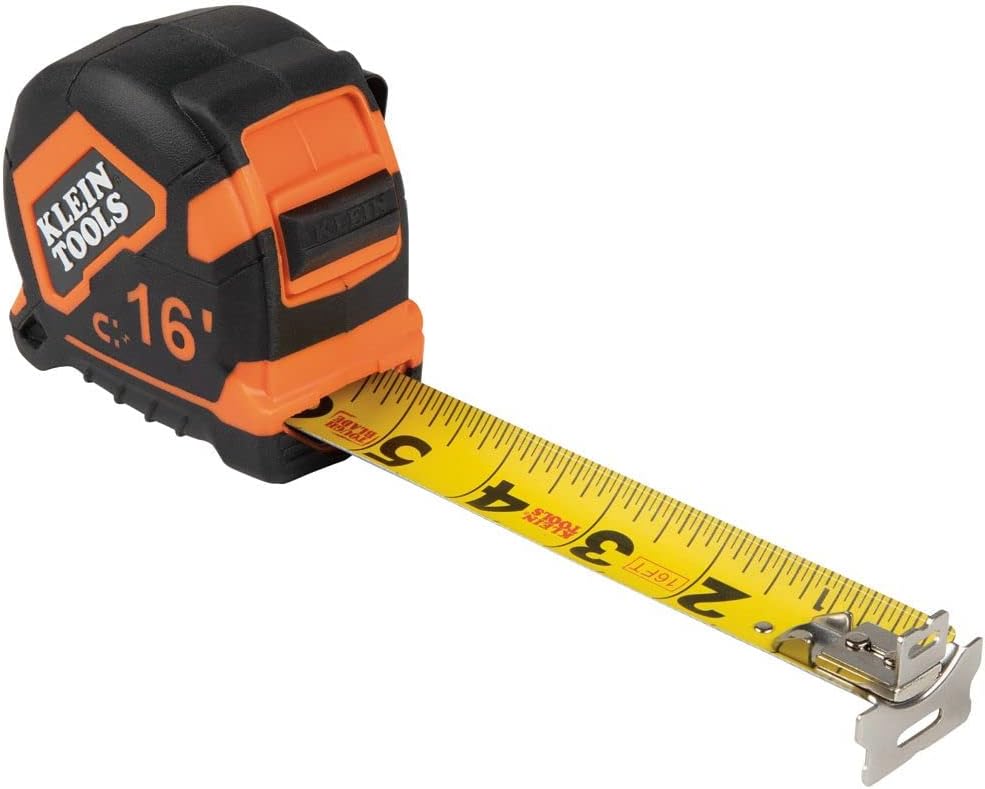 Klein Tools 9216 16 ft Double-Hook Magnetic Tape Measure
One room needs three numbers, and the magnet holds the end of the tape while you take them alone. Double hook and a magnet on the end, so it stays put on a board edge or a steel stud while you read the other end solo.
16 ft, double-hook with magnet, dual-sided blade
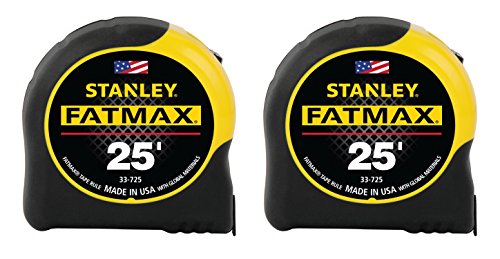 Stanley FMHT74038A FatMax 25 ft Tape Measure, 2-Pack
Long enough to cross a 12-foot room without the blade folding, which keeps the length honest. An 11-foot standout means you can run it out along a long board or across a room on your own. Two in the box, so one lives in the shop.
11 ft standout, 16 in / 19.2 in stud markings
As an Amazon Associate we earn from qualifying purchases — buying through these links may earn us a commission at no extra cost to you. See our full disclosure. We do not show prices here because Amazon's change constantly; the button takes you to the current one.
There are two ways to end up unhappy at the end of a painting job: run out with one wall left to go and have to buy a fresh gallon that dries a shade different, or buy three gallons for a job that needed one and leave two to skin over in the garage. The paint calculator above keeps you out of both ditches. Give it the room's dimensions, subtract the doors and windows, choose how many coats, and it tells you how many gallons of wall paint to put in the cart. Tick the ceiling box and you get a second, separate figure for ceiling paint, because that is a different product in a different can.
This guide walks through the simple area maths behind that number, the coverage rates you can trust, and the real-world adjustments — primer, dark colours, textured walls — that the raw formula does not know about.
How paint coverage works
Estimating paint comes down to two quantities: how much surface you are covering and how far a gallon goes. Get those two right and the rest is division.
The surface is wall area. For a rectangular room you do not measure each wall separately — you measure the room's perimeter and multiply by the ceiling height. Then you subtract the openings you are not painting: the doors and windows.
The coverage is the part people guess at, usually badly. A gallon of interior latex covers a fairly predictable amount of wall, and the manufacturers all quote a similar figure.
The paint formula
Here is the calculation the tool runs, broken into its steps:
The first line is just the perimeter of the room — twice the length plus twice the width — multiplied by how tall the walls are. The second line takes that paintable area, multiplies by the number of coats, and divides by how far a gallon stretches. The third is the ceiling, which the tool costs on its own at one coat and rounds up to its own whole cans.
A worked example. A 12 × 12 foot room with 8-foot ceilings, one door and one window, painted in two coats:
- Wall area = 2 × (12 + 12) × 8 = 384 square feet
- Subtract a door (20 sq ft) and a window (15 sq ft) = 384 − 35 = 349 square feet
- Wall gallons = 349 × 2 coats ÷ 350 = 1.99 → buy 2 gallons of wall paint
That is the answer the calculator gives for the walls, and it matches what the paint-store estimators will tell you about walls. The ceiling is a separate line of the shopping list, worked out below. The live formula strip beneath the tool shows your own room's numbers running through the same steps — and a second strip appears for the ceiling when you tick it, so the published formula is the one the tool actually ran.
Standard sizes the calculator assumes
You could measure every door and window, but for estimating it is faster to use standard sizes — and that is what the tool subtracts for each opening you count.
The door slab itself measures nearer 18 square feet; the 20 square foot allowance is the figure This Old House and Home Improvement For Dummies both use, and it covers the slab plus the jamb and trim around it that you are not rolling either. Window allowances genuinely vary between sources — This Old House deducts 10 square feet, Dummies and Behr 15 — and the tool takes 15, the larger deduction.
If your room has a wall of glass or an oversized opening, count it as two openings so the right amount of wall comes off the total. Going the other way — entering fewer doors and windows than you have — does not shave the estimate, it raises it, because every opening you leave out is wall the tool thinks you are painting. That is a deliberately safe direction to err in, but know which way it pushes. For most rectangular bedrooms, living rooms and offices, one door and one or two windows is all you need to enter.
How far different paints go
The 350 default is right for ordinary interior wall paint on a previously painted, smooth surface. Other situations change the coverage, and you can type a different number into the Coverage field to match.
The pattern is intuitive once you see it: the rougher or thirstier the surface, the less area a gallon covers. Bare drywall, raw wood, textured plaster and stucco all pull more paint out of the can than a smooth, sealed wall. When you are working on any of those, drop the coverage figure and let the calculator buy you a little more.
The ceiling row is worth reading twice, because it is exactly what the tool does: flat ceiling paint at one coat on a sound, previously painted ceiling. Walls get the two coats a colour change needs; a ceiling going back on in the same white does not, and costing it at two is how people end up with three unopened gallons. If your ceiling is bare plaster, stained or changing colour, treat it as a two-coat job and buy a second can on purpose rather than by accident.
How to use the calculator
- Room length, width and height in feet. A quick tape measure read of the floor and one wall is all it takes.
- Doors and windows. Enter how many of each; the tool subtracts standard sizes.
- Coats. This is the coat count for the walls. Two is the realistic default for a quality finish, and for any colour change. One coat only works when you are refreshing the same colour over a clean, sound surface.
- Coverage. Leave it at 350 for normal walls, or lower it for bare or textured surfaces using the chart above.
- Ceiling. Tick the box if you are painting the ceiling too — the tool works out the ceiling's area (length × width) and costs it on its own at one coat.
You get two numbers, not one: gallons of wall paint, and — when the ceiling is ticked — gallons of ceiling paint. Each is rounded up to whole cans on its own, because that is how paint is sold and because the two are different products. A spare third of a gallon of wall paint is no use to you on the ceiling. Underneath each figure you will see the exact gallons needed, and a breakdown of wall area, openings, paintable walls and ceiling area.
Real-world adjustments the formula can't see
The maths is honest, but a paint job has variables a calculator cannot measure. Build these into your decision:
A few more habits that keep the estimate accurate:
- Always prime bare or repaired surfaces. Primer is cheaper than topcoat, seals the surface so your colour goes on evenly, and means you actually get the coverage the can promises. New drywall, patched holes and raw wood all need it.
- Buy trim and wall paint separately. Trim and doors usually take a different sheen (semi-gloss) and a small amount goes a long way. Estimate them on their own rather than rolling them into the wall total.
- Keep a labelled jar of leftover paint for touch-ups. A small surplus is genuinely useful; two unopened gallons are just clutter. The calculator's round-up usually leaves you the right amount.
- Box your paint. If you do buy multiple cans of the same colour, pour them together into one larger container and mix before you start. It evens out any tiny batch-to-batch colour difference across the whole room.
Painting is one of the highest-impact DIY jobs for the lowest tool cost — a decent roller, a brush, a tray and some tape. If you are putting together your first kit, our best DIY tool kit for beginners and the broader essential DIY tools guide cover what is worth owning before you start.
Measure your room in two minutes
You do not need to measure all four walls. For the calculator you need just three numbers: the room's length, its width, and the ceiling height. Run a tape along two adjacent walls at floor level for length and width, then measure floor to ceiling once for the height — standard ceilings are 8 feet, though older homes and new builds often run 9 or 10. Round to the nearest foot; paint estimating does not reward fractions of an inch, and the conservative 350 coverage figure already builds in a little slack.
For an irregular, L-shaped or open-plan space, split it into rectangles in your head, estimate each as its own "room," and add the gallons together. Vaulted or sloped ceilings are the one case worth measuring carefully, since the extra triangle of wall above the normal ceiling line adds real area — measure to the highest point and treat the gable end as an extra opening's worth of wall rather than guessing low.
Match the finish to the room
The calculator tells you how much, but choosing the right sheen matters just as much to how the job looks and lasts. Sheen is how glossy the dried paint is, and it is a genuine trade-off between hiding flaws and surviving scrubbing.
- Flat / matte hides wall imperfections best and is the usual choice for ceilings and low-traffic adult bedrooms. It is the hardest to clean, so keep it away from busy spaces.
- Eggshell and satin are the everyday middle ground — a soft, washable finish that suits living rooms, hallways and most walls. Satin is the slightly tougher of the two.
- Semi-gloss and gloss shrug off moisture and scrubbing, which makes them right for kitchens, bathrooms, trim, doors and anything little hands touch. The shine does highlight every bump, so the surface underneath has to be smooth.
A common, reliable scheme for a whole house: flat on the ceilings, eggshell or satin on the walls, and semi-gloss on the trim and doors. Because trim takes so little paint, estimate it separately — a single quart often does the doors and baseboards of an average room.
Painting a whole house? Estimate room by room
It is tempting to measure a whole floor at once, but the openings and ceiling heights vary too much room to room for one big number to be accurate. Run each room through the calculator on its own and note both figures — wall gallons in one column, ceiling gallons in another — then total the two columns separately at the end. Then look for paints you can share: every room getting the same wall colour can pool into one larger order — which is usually cheaper per gallon and guarantees a perfect colour match — while bathrooms and kitchens in a moisture-friendly sheen get their own. Buying by the room but pooling by the colour is how professionals keep both the budget and the colour consistent across a big job.
Frequently asked questions
How many gallons of paint do I need for a 12x12 room?
About two gallons for two coats on the walls, after subtracting a door and a window. That covers roughly 349 square feet of wall twice over at 350 sq ft per gallon. Add another gallon if you are also painting the ceiling — a 12 × 12 ceiling is 144 square feet, so one coat needs well under a full can, but it has to be a can of ceiling paint, bought separately from the wall gallons rather than counted among them. A bold colour can also push the walls to a third can.
How much does a gallon of paint cover?
Around 350 to 400 square feet for one coat of interior latex on a smooth, previously painted wall. Rough and bare surfaces cover less: reckon on 200 to 300 square feet for primer, and 200 to 250 for a gallon going onto rough exterior render or stucco.
Do I subtract doors and windows?
Yes, for a tighter estimate — the calculator removes 20 square feet per door and 15 per window. If a room has very large openings, count them generously so you do not over-buy.
How many coats of paint do I need?
Two is standard for a durable, even finish and essential for any colour change. One coat suffices only when refreshing the same colour over a clean, sound surface. Dark or vivid colours often need a tinted primer plus two coats.
Should I include the ceiling in the calculation?
Only if you are painting it. Tick the ceiling box and the tool works out the ceiling's area (length × width) and gives it its own gallon figure, at one coat, rounded up separately from the walls. Ceilings usually take flat ceiling paint, which is a different product from your wall colour — so it is a second line on the shopping list, not a bigger number on the first.
Use this estimate to shop with confidence, but treat it as a well-judged starting point rather than a guarantee — surface texture, colour and application method all move the real figure. When the result lands right on a round number, buying one extra quart for touch-ups is cheap insurance against that last awkward patch.
About the Author
Cheryl Thompson
Cheryl Thompson is the tools editor at The DIY Tool Review. A lifelong fixer and self-confessed tool addict, she has spent years buying, borrowing and wearing out hand and power tools across home renovation, furniture building and everyday repairs. She writes hands-on, no-nonsense reviews to help fellow DIYers spend their money on the tools that actually last.